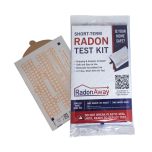
A radon test is a passive device (typically a charcoal canister or alpha track strip) that you place in your home for a set period, then mail to a laboratory for analysis. You receive a single average number days or weeks later. A radon monitor, such as the Rn One, measures radon levels in real time, 24 hours a day, and displays results on the device itself. Because radon levels fluctuate daily and seasonally, continuous monitoring provides a much more complete picture of your home's actual exposure than a one-time test result.
The Rn One Home Radon Monitor uses an ionization chamber sensor that detects alpha particles released during the radioactive decay of radon gas. The device counts decay events over time and calculates radon concentration. It provides a first reading in approximately 10 minutes, a reliable 1-hour average, and progressively more accurate averages over 24 hours, 7 days, and 30 days. Long-term averages are accurate to ±10%.
The World Health Organization (WHO) recommends a reference level of 2.7 pCi/L (100 Bq/m³) for homes. If your long-term average radon reading consistently exceeds your country's reference level, professional radon mitigation is recommended. The Rn One Home Radon Monitor displays simple color-coded indicators (green, yellow, red) that you can align with WHO or national reference levels through the Aranet Home app.
Place the radon monitor on the lowest regularly occupied floor of your home, typically a basement or ground-floor living area. Place it at least 20 inches above the floor, away from exterior walls, windows, doors, and areas with high airflow. Avoid kitchens, bathrooms, and laundry rooms. Radon enters from the ground, so lower floors generally have higher concentrations.
The Rn One Home Radon Monitor runs on two standard AA alkaline batteries and is designed to operate for 5+ years under typical conditions. This is made possible by the E-Ink display, which draws power only during screen refreshes, and proprietary energy management technology (patent-pending). Batteries are included in the box. No power outlet, charging cable, or USB connection is needed.
No, Rn One operates independently without Wi-Fi. The device measures, calculates, and displays radon levels entirely on its own. The Aranet Home app connects via Bluetooth to retrieve stored data, view trend charts, and configure alert thresholds. Bluetooth syncing requires the app to be within range, but the monitor itself does not depend on any network connection to function. The Aranet App is available at Google Play and App Store.
The green, yellow, and red bars indicate radon concentration levels relative to configurable thresholds. Default thresholds are set following WHO radon guidelines. You can adjust these thresholds through the Aranet Home App (found on Google Play or Apple App Store) to match your national reference levels. Green indicates levels are within the recommended range. Yellow indicates levels are approaching the action threshold. Red indicates levels that exceed the reference level and warrant further investigation or mitigation.
Radon levels fluctuate from hour to hour and season to season. A minimum monitoring period of several weeks is recommended before drawing conclusions. Longer monitoring periods (3 months or more, ideally across both heating and non-heating seasons) produce a more reliable long-term average. If readings consistently exceed your national reference level over an extended period, contact a licensed radon mitigation professional at radon.com/findpro).
Yes. The Rn One Home Radon Monitor is battery powered and fully portable. You can move it to different rooms to compare radon levels across your home. Keep in mind that each time you relocate the device, it takes time to establish a new baseline in the new location. Allow at least 24 hours in the new position before interpreting results. You may consider placing a radon monitor on each level of your home. The Aranet Home app stores historical data from all locations.
A properly performed short-term test provides a valid snapshot for the testing period. Radon levels can vary significantly from day to day and across seasons. A continuous radon monitor measures these fluctuations over time and produces long-term averages that are more representative of your actual annual exposure. Health agencies including Environmental Protection Agency (EPA) and World Health Organization (WHO) recommend long-term measurements for the most reliable assessment of residential radon risk.